

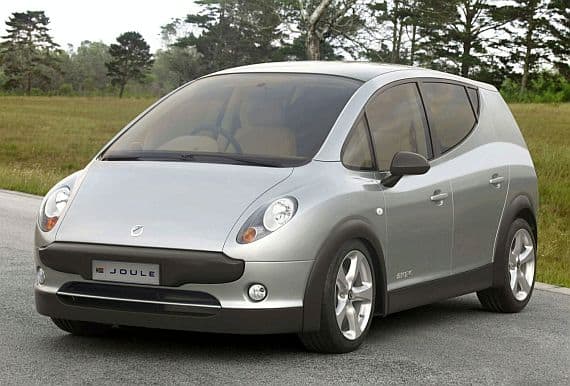
Remember the Joule EV from the 2008 Paris Auto Show? Well if you see it at this year’s Geneva Auto Show, you will not really be able to recognize it given the amount changes the South Africa-based Optimal Energy designed commuter has undergone.
It is a near production ready variant that gets a showcasing in Geneva featuring revised styling changes and production ready equipment. Initially, only 100 prototypes of the Joule EV will be manufactured for testing and development purposes following which the EV will hit thorough production in the later half of 2012.
All these prototypes will be hand-built by Hi-Tech Automotive and once production begins it will be Germany’s EDAG and South Korea’s Energy Innovation Group who will supply the parts. The Joule EV is touted to have a maximum range of 143 miles when using the New European Driving Cycle or 186 miles when running on the Urban Dynamometer Driving Schedule.
There are a number of interesting electric vehicles at the Geneva event this year ranging from the EV Tata Nano to the Tag Heuer Tesla Roadster and the latest addition is the Westfield iRacer. Categorically, the Westfield Racer is an EV racer which is designed to compete in the EV Cup which is a one-make race car series launching in 2011.

The iRacer version unveiled in Geneva is closest to the production model and the designer Elliott Hawkins believes that it has electric pulse running through its veins. The body construction material such as aluminum and recyclable plastics keeps the overall car weight down to 600kg. On the inside, the Westfield iRacer is powered Lithium Phosphate battery which produces 109PS with 1,000Nm of torque and this combination helps the car pelt from 0 to 60mph in less than 5 seconds with an overall top seed of 177km/h.

BMW is keen to offer eco-friendly options to the world and a decision has been made to assemble the electric cars at the Leipzig facility. BMW chose the facility for its flexibility and capability for increased capacity. Models like the ActiveE, an electric variant of the 1series, will be produced in limited lumbers up front and then the Megacity EV will be rolled out in 2013. While the assembly will be in Leipzig spare parts will also be built in Wackersdorf and Landshut while the Li-on batteries will come from SB LiMotive which is joint venture between Samsung and Bosch. Megacity will be a battery laden commuter and carbon fiber usage will ensure high economy courtesy of the low overall weight.
The green minded have another reason to smile as the French from Citroen have announced that their C-Zero electric vehicle concept will actually see daylight by the end of 2010. Powered by a permanent magnet synchronous motor that outputs 64 bhp and 180Nm of torque, the C-Zero also gets a 16kWh energy boost from a 330-volt lithium-ion battery. All these help it reach 100km/h in 15 seconds and give the car a 130 km range — enough for your daily commuting.

The new Citroen C-Zero EV only takes 6 hours to fully charge at 220V and only 30 minutes on a 400V plug if you can settle with only 80-percent. Fitted with ABS, electric windows, air conditioning, ESP and six airbags, the new C-Zero is expected to hit the road by the end of 2010. [via WCF]
Nissan has always been unsure about the success its alternative-fuel car in the US but it has in store is bound to change the trend next year. And, the confidence oozes from the fact that the Nissan Leaf (its first pure-electric car) will be a US only model. The design form belongs to the category of a front-drive C-segment Hatch which can seat four to five people. The company has great emphasis on the ability of this car which can behave an as everyday option rather than some specialty with its 100-mile range. Nissan believes that this range should be ample given the number of people who drive less than those 100 miles in s day (the figure stands at 80%).

A lot of emphasis has been laid on the design to ensure that the appearance is unique but not something bizarre or strange. The rarity of the car also lies in its powertrain as it churns out 90 kW of power using a array of thin, laminated lithium ion cells, while it’s front-mounted electric motor delivers 80 kW with 208Nm of torque. This helps the car clock 140km/h when the throttle is choked to the floor.
There isn’t mush left to think with the automakers around the globe going green, thus seemingly, Nissan has also followed the trend. Its latest EV prototype (zero-emission car) based on the Tida has an impressive set of specs. To begin with, it houses a 24kWh laminated compact lithium-ion battery that delivers high power output and energy capacity. Placed under the floor, this battery makes 80kW with 280Nm of Torque.

The prototype uses seamless acceleration which is being touted as very responsive. It is the braking that recharges the battery during deceleration-something we’ve heard of before. If the driver uses to a good affect, he can add another 160km from a full charge. The rigid body structure and platform minimizes the vibration and external sounds. Also, the EV-IT system ensures that full-electric driving can be managed 24 hours a day; thanks to a global data center supporting the function. There a display monitor that reflects the battery time left and whether the pre-set destinations or the available recharging stations on the Sat-Nav can be reached or not. For the production version there will be a totally different car design and it should hit the floors next year. [via Autoblog]

Geneva has been great this year. With accents on green vehicles and luxurious rides, we’re know you’d have badmouth us for not telling you more about the Protoscar Lampo. Announced in February, the Swiss went live with it a few days ago, and we managed to find more details. Powered by two special BRUSA getting their juice from a lightweight li-ion battery capable of storing 32 kW, the electric vehicle accounts for a good 268 hp and 440 Nm torque, and offers a 193 km range. There’s no release date or a price for that one, but if anyone from Protoscar cares we’re available for a test drive. Call us! [via WCF]

Now if those 1,100 guys waiting in line for a Roadster are not mad enough and can wait a few more months, our advice is to save more money and wait for the new sports version. Dubbed Tesla Roadster Sport, the two-seater electric vehicle is now 15-percent more powerful thanks to a hand-wound stator that increases winding density and helps eliminate resistance. The car also sports better handling, a unique paint job with carbon accents and a set of ultra high performance tires. Doing naught to 100km/h in only 3.7 seconds – unlike the base model that takes 3.9seconds – the car is expected to be deliver starting from June and the price is expected to start from $128,500 in the US. [via Jalopnik]


It’s not a surprise anymore that the world economy is facing recession, and the market evolutions all over the world are not favorable to those that buy. That’s the same idea with oil. For the last 8 to 12 months oil managed to reach up to $145 (and more) which brought higher prices for the fuel we put in our cars.

Therefore, car manufacturers are trying to keep up with the trend and come up with modern hybrid technologies that will increase the mpg, or with electric vehicles that became fashionable lately. Knowing that Audi already tried the market with their A2 (back in the days), that makes me thing they will probably be into this electric vehicle thing with a strong position.
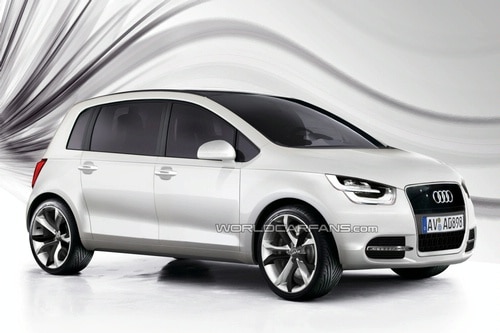
Our friends at WCF managed to come up with a rendered design of what it may look like. With an elevated floor, some chrome and lacquer finishes, LEDs and fiber optics in the lights and some fancy wheels, the new to come Audi EV could be a real success.

I’ve just managed to get some pictures with the newest leaked car from Nissan. It’s an electric vehicle dubbed Nissan Denki Cube, still a concept, that we will probably see on the floor at the New York International Show tomorrow. Aside from its design it has great specs. The car is able to run at 75 mph (top speed) for about 100 miles without the need to charge the battery. The 2009 Nissan Denki Cube is built in partnership with NEC and takes 8 hours to charge the lithium-ion battery.Do you like it?